Miss Sherina Balaratnam explains why the internet’s favourite insult is really a question of muscle physiology, and how EMFACE is designed to work against it.
‘Bitchy resting face’ has been an internet punchline for well over a decade, used more often than not to describe a woman’s neutral expression as though it needs explaining. Ask any facial anatomist and the real explanation has nothing to do with mood. At S-Thetics Clinic, Miss Sherina Balaratnam uses the term as a way into a more useful conversation: what actually happens to the muscles around the mouth and jaw as we age, and what EMFACE and other treatments can realistically do about it.
Bitchy resting face: the science behind it
What’s really pulling your face down
As we age, a specific group of muscles, the depressor anguli oris, mentalis and platysma, begin to exert a steady downward pull on the lower face. Their job is to help form expressions such as a frown. Over time, and with the gradual loss of facial fat and skeletal support that comes with normal ageing, they can settle into a stronger resting position than the muscles that lift the face back up. The result can look like a scowl even when someone feels perfectly neutral, which is where the label tends to land, unfairly, on a face that has done nothing more than age normally.
Bitchy resting face isn’t attitude. It’s anatomy.
Miss Sherina Balaratnam, Medical Director
The hidden muscle imbalance behind facial ageing
How EMFACE works
Where anti-wrinkle treatment reaches its limit
For injectors, anti-wrinkle treatment across these depressor muscles is one of the main tools for giving the mid and lower face a fighting chance of staying up. Softening the downward pull buys the lifting muscles some room to work. But toxin relaxes muscle; it does not rebuild it. That leaves a gap for anyone wanting a longer-term change in muscle tone rather than a temporary pause on the pull.
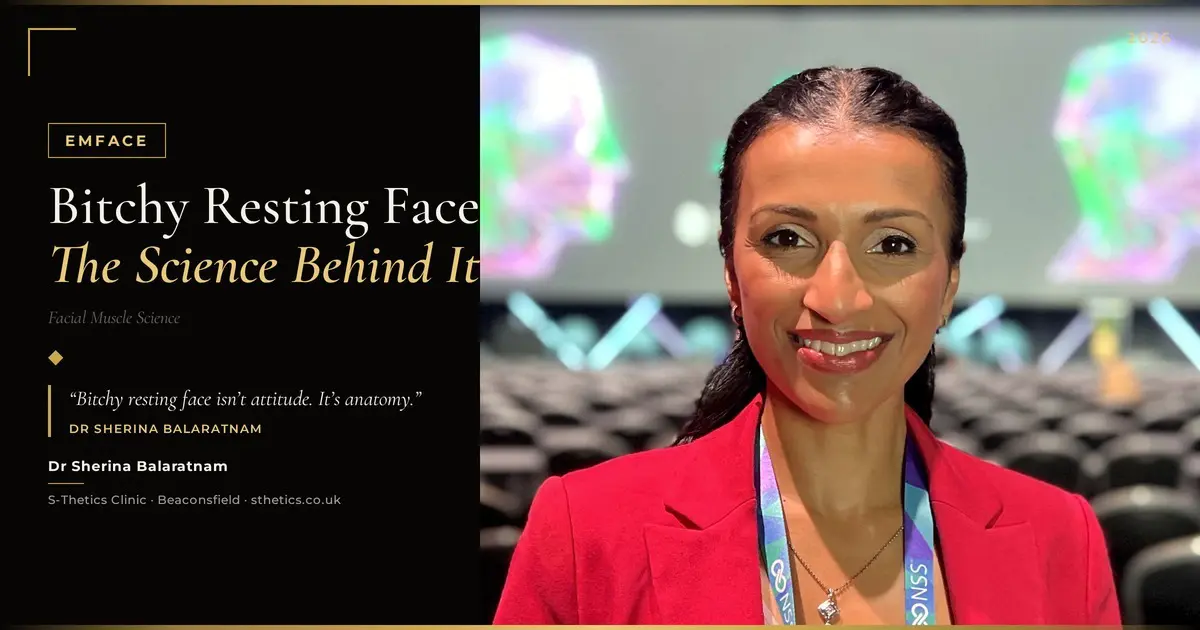
Bitchy resting face, EMFACE and the case for lifting rather than relaxing
- EMFACE: pads placed over the cheek and forehead deliver strong muscle contractions, repeated hundreds of times in a single session, alongside radiofrequency heating of the skin. BTL describes these contractions as reaching an intensity voluntary effort cannot. A course of sessions is designed to improve facial muscle tone and tissue support, rather than simply holding the muscle still.
- Anti-wrinkle treatment: still plays its part in softening the downward-pulling depressor muscles, working alongside EMFACE rather than instead of it.
Why facial muscles matter more than you think: EMFACE explained
Who this is not for
A downturned resting expression is not always muscle. Volume loss, skin laxity and dental or jaw changes all play a part, and some of those need a different answer. EMFACE is also not suitable for everyone, including during pregnancy or with certain metal implants in the face. A consultation looks at the whole face before recommending anything.
Why Miss Balaratnam combines EMFACE with injectables
What this means for our patients
For patients who have had the term used against them, or who notice their expression settling into a shape that does not match how they feel, this is the more useful starting point: a conversation about muscle tone, contraction and what is realistically achievable over time. Some patients start with anti-wrinkle treatment alone, others move on to a course of EMFACE once the depressor muscles are softened, and many do both in parallel. The plan is built around what is happening in the muscle, not around a label that was never fair in the first place.
→ Book your consultation, including a full imaging session in our Aura suite
S-Thetics Clinic · 45 Wycombe End, Beaconsfield HP9 1LZ · 01494 670990 · sthetics.co.uk
About the author
Miss Sherina Balaratnam MBBS MRCS(Edin) MSc(UCL) is Medical Director of S-Thetics Clinic in Beaconsfield. She qualified in medicine in 1998, and her career includes seven years in reconstructive plastic surgery in the NHS and 16 years in aesthetic medicine. She is a Tatler Top Doctor 2026 and a global key opinion leader for BTL Aesthetics and Celluma.