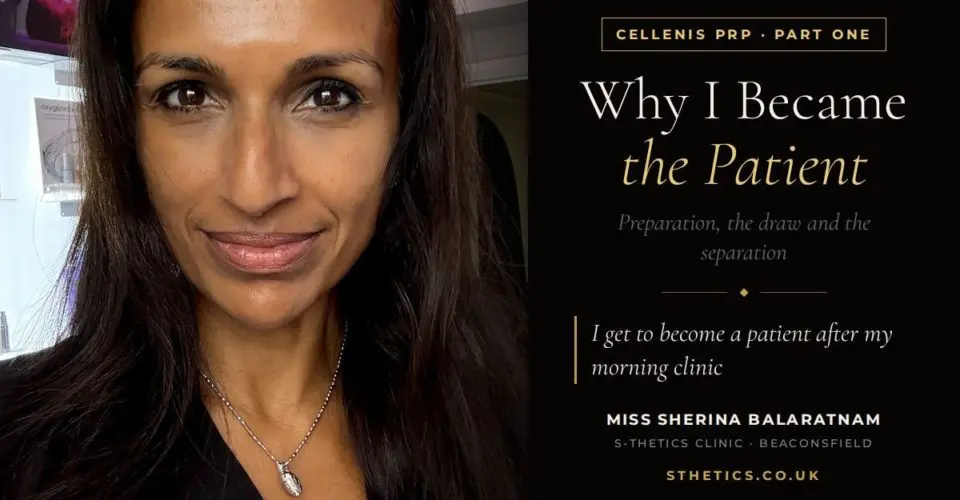
Miss Sherina Balaratnam finished her morning clinic, kept her scrubs on, and sat down in the patient chair for a Cellenis PRP treatment she has been having since 2020.
There is a particular kind of credibility that comes from a clinician choosing a treatment for herself. Miss Sherina Balaratnam, Medical Director at S-Thetics Clinic in Beaconsfield, had a full session of Cellenis PRP with Cheryl Marshall-Williams, Aesthetic Nurse Practitioner, covering the scalp, face, neck, décolletage and the backs of the hands. We filmed it from start to finish.
Cellenis PRP part one: preparation
What platelet-rich plasma actually is
Cellenis PRP begins with a small sample of your own blood, taken in clinic in the ordinary way. That sample goes into a centrifuge, which separates it so the plasma and platelets can be drawn off and returned to the tissue. Nothing synthetic is introduced and nothing is added. What goes back in is a concentrated part of what came out.
Cheryl demonstrates this during the session by turning the separated tube upside down. No blood runs back. What remains in the upper layer is the plasma, and that is what is used across every area treated.
I can turn this upside down and still I don’t get blood back.
Cheryl Marshall-Williams, Aesthetic Nurse Practitioner
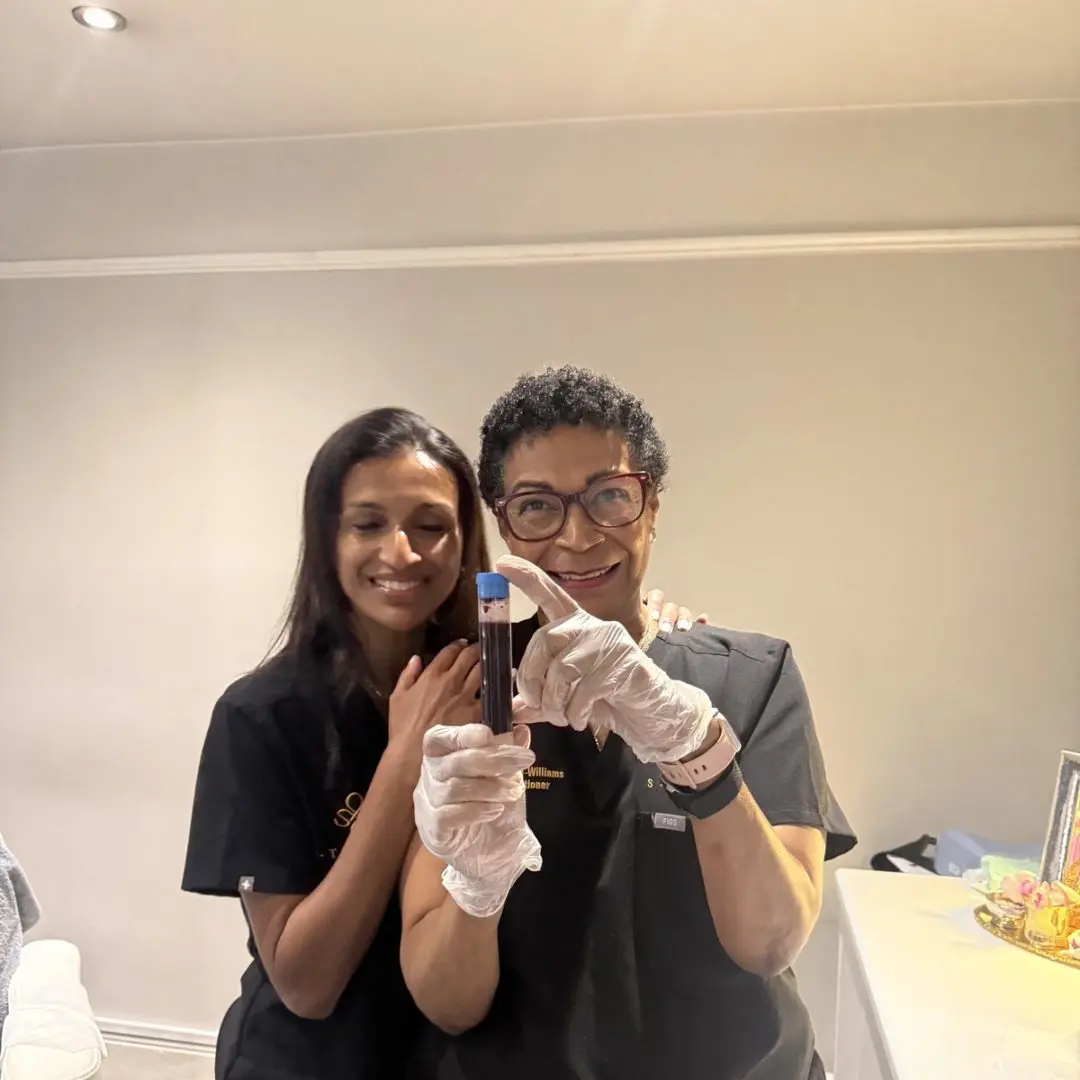
Liquid gold: how your blood is prepared for PRP
Platelet-rich plasma explained
Why the scalp is prepared first
The part of the session that surprises most patients is how much attention goes into the scalp before any treatment begins. Cheryl cleanses and exfoliates first, on the principle that the follicle is what matters, and the follicle sits under a surface most of us never actually clean.
Her analogy is a garden. Anything applied to ground that has not been prepared will struggle to reach the root. Washing your hair and cleaning your scalp are, as she puts it, two quite different activities.
Cellenis PRP part two: the scalp
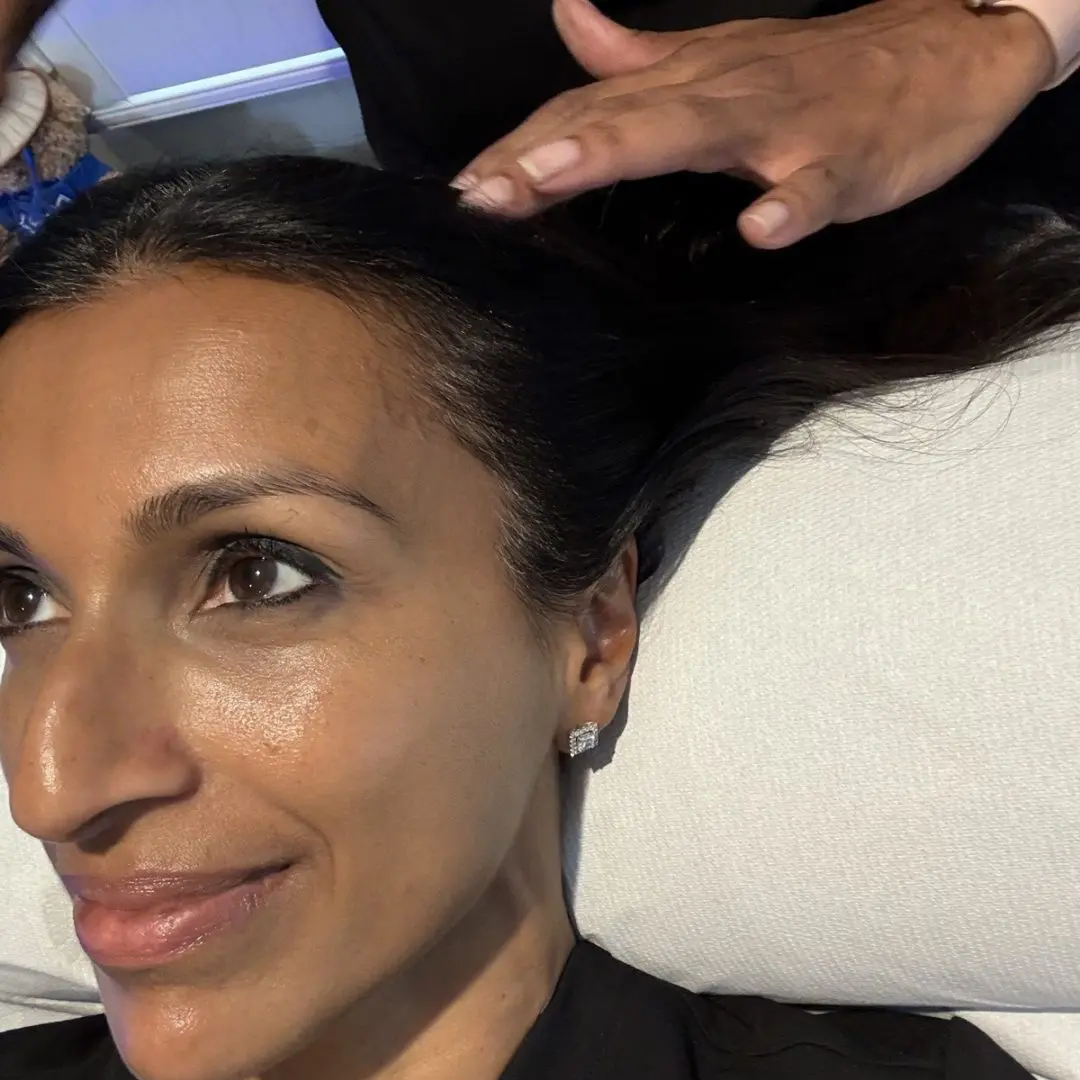
The areas treated in one Cellenis PRP session
A single draw covers everything. In Miss Balaratnam’s session that meant five areas, each with its own technique and depth.
- Scalp: treated by hand rather than with a device, and without topical anaesthetic. Cheryl works at a shallow depth across the areas where thinning is most common.
- Face: placed just below the surface of the skin, which raises small areas that settle over the course of about an hour.
- Neck and décolletage: treated in the same way as the face, for skin quality and texture in areas that show sun exposure.
- Backs of the hands: the area patients tend to forget until they notice it, treated at the end of the same session.
Who PRP is not for
Cellenis PRP is not an immediate treatment, and it is not presented as one. It works gradually, which is why Miss Balaratnam has hers every six to eight months and thinks of it as maintenance rather than an event. It is not suitable for everyone: some blood disorders, certain medications and active infection rule it out, and sudden or patchy hair loss needs a medical diagnosis first. That is what the consultation is for.
I get to become a patient after my morning clinic.
Miss Sherina Balaratnam, Medical Director
What this means for our patients
If you are considering PRP, the honest framing is that it suits people who are willing to think in months. It uses your own biology, it is delivered by an experienced nurse practitioner, and it can address several areas in one visit. Miss Balaratnam combines it with an at-home routine and other treatments in clinic, such as Profhilo, on the view that no single thing does everything.
→ Book your consultation, including a full imaging session in our Aura suite
S-Thetics Clinic · 45 Wycombe End, Beaconsfield HP9 1LZ · 01494 670990 · sthetics.co.uk
About the author
Miss Sherina Balaratnam MBBS MRCS(Edin) MSc(UCL) is Medical Director of S-Thetics Clinic in Beaconsfield. She qualified in medicine in 1998, and her career includes seven years in reconstructive plastic surgery in the NHS and 16 years in aesthetic medicine. She is a Tatler Top Doctor 2026 and a global key opinion leader for BTL Aesthetics and Celluma.