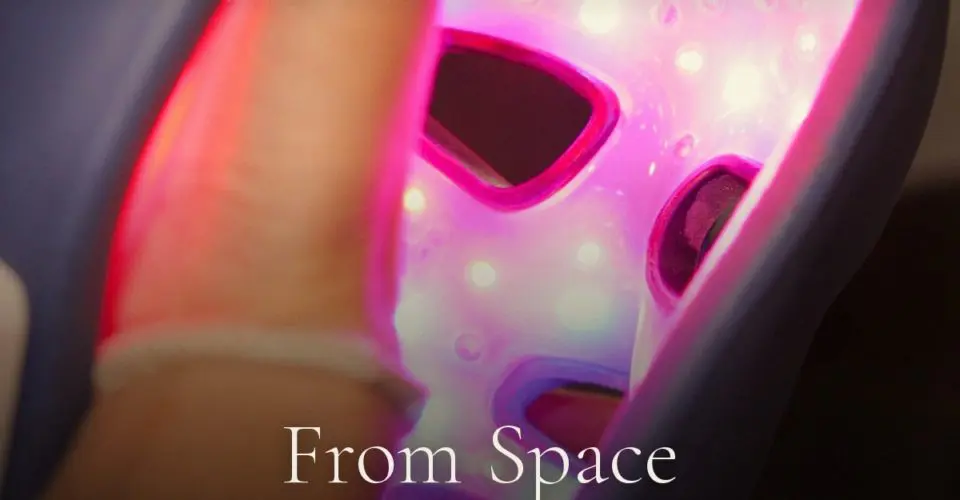
From Space to Skin: The NASA Research Behind Light Therapy
Miss Sherina Balaratnam traces light therapy back to its unlikely origin, a problem about healing in orbit, and explains why that history still matters.
When patients ask whether red light therapy is just a passing trend, I tell them where it actually comes from. Not a beauty counter, but a NASA laboratory, and a question about how the human body heals when gravity is taken away. I find it a genuinely compelling story, partly because the science it rests on is the same science I studied at university.
A discovery that began with plants, not skin
The light-emitting diodes at the heart of modern therapy were not designed for skin at all. They were developed for NASA plant-growth experiments in space, using red and near infrared wavelengths to drive photosynthesis where natural light could not be relied upon. The medical interest came later, and almost by accident. Long missions face a stubborn problem: in the absence of gravity, astronauts lose muscle and bone, and wounds heal slowly. If light could energise plant cells, the reasoning went, perhaps it could do something for human ones.
The Marshall connection
Between 1995 and 2003, a series of NASA Small Business Innovation Research contracts, most of them through the agency’s Marshall Space Flight Center, funded a sustained programme of work on the medical uses of LEDs. It brought together Quantum Devices, a Wisconsin LED manufacturer, and Dr Harry Whelan, a neurologist at the Medical College of Wisconsin. Over those years the team moved methodically from cell cultures to animal models to human trials, the last of these approved by the FDA.
What the research actually found
The findings were consistent. High intensity red and near infrared light accelerated the healing of oxygen-deprived wounds and encouraged the growth of skin, bone and muscle cells in culture. The devices delivered three wavelengths in a single array, 670, 720 and 880 nanometres, each chosen for how it behaves at a different depth in tissue. The proposed mechanism was not heat, and not force of any kind, but energy. Light absorbed by the cell appeared to support the production of cellular energy, growth factors, collagen and new blood vessels. In other words, it seemed to help the body do a little more efficiently what it already does.
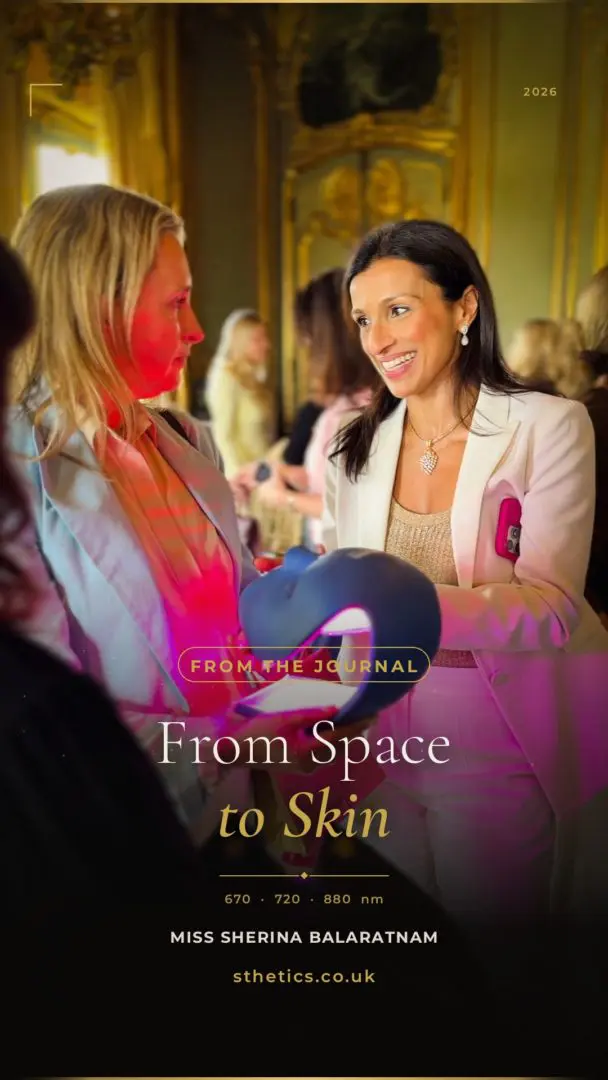
This did not begin as beauty. It began as a question about how the body heals.
Miss Sherina Balaratnam, Medical Director
From submarines to clinics
The work did not stay in the laboratory. LED arrays were issued to United States Navy crews to treat training injuries, where they were reported to improve musculoskeletal recovery and to roughly halve the healing time of minor lacerations compared with untreated controls. The same principles were studied in diabetic ulcers, in serious burns, and in the painful mouth ulcers that follow chemotherapy and radiation. Step by step, light therapy moved from a space programme into mainstream medicine, and from there into the aesthetic clinic.
Why this history matters when you choose a device
I take a particular interest in this lineage. My MSc at University College London was in Surgical Sciences, and my thesis examined photodynamic therapy, photobiomodulation and cell biology, the very mechanisms this NASA research helped to establish. So when I assess a light device for the clinic, I am not reading the marketing. I am looking for what decades of research say actually matters: clinically supported wavelengths, an appropriate dose of energy, and a design that delivers it properly to the skin. The Celluma MYSTIQUE we use at S-Thetics sits at the end of that long line of evidence, not apart from it.
Light therapy is not new, and it is not magic. It is the practical inheritance of a serious body of science that began, improbably, with the problem of keeping astronauts well. Understanding where it came from is the surest way to judge what is worth your time today.
→ To discuss whether LED light therapy suits your skin, book a consultation at sthetics.co.uk/book
S-Thetics Clinic, Marlborough House, 45 Wycombe End, Beaconsfield HP9 1LZ
About the author
Miss Sherina Balaratnam (MBBS, MRCS(Edin), MSc(UCL) is the Medical Director of S-Thetics Clinic in Beaconsfield. A Tatler Top Doctor and peer voted UK Aesthetic Doctor of the Year, she has 26 years of experience as a qualified doctor, including a 7 year background in NHS reconstructive plastic surgery, and 14 years specialising in aesthetic medicine. Her MSc in Surgical Sciences at University College London included a thesis on photodynamic therapy, photobiomodulation and cell biology. She co-authored the Oxford Textbook of Aesthetic Surgery.