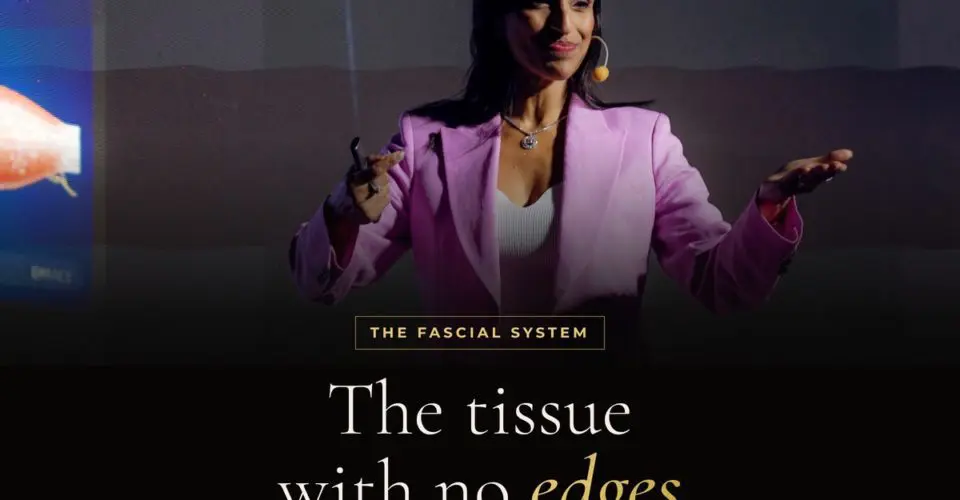
Fascia and facial ageing: the tissue with no edges
One of the body’s most important tissues was long dismissed as packing. Miss Sherina Balaratnam on what fascia is, and what it teaches us about the ageing face.
For most of medical history, one of the most consequential tissues in the body was treated as something to scrape away. Today, fascia is being recognised as a single, body-wide network that connects everything within us, and it is quietly reshaping how thoughtful clinicians read and treat the face.

The tissue we were taught to discard
In the dissection room, fascia was cut and cleared so that students could reach the “real” anatomy beneath it: the muscles, the vessels, the nerves. We were, in effect, taught to understand the body by removing the very thing that held it together.
It was surgery that taught me otherwise. Across seven years in NHS reconstructive plastic surgery, fascia was never the tissue you discarded. It was the tissue you relied on. You followed its planes to move safely through the body, you preserved it where it mattered, and you used it to rebuild, raising flaps and grafts from the very material the anatomy room had trained me to clear away. The thing dismissed in teaching turned out to be one of the most useful structures in the operating theatre.
A single, body-wide network
Fascia is not mere padding. It is a continuous, body-wide network of connective tissue that surrounds, separates and links every muscle, organ, bone and nerve. It has no true edges, no point at which it starts or stops, and every other structure is held somewhere within it. In 2014 an international committee of anatomists and researchers proposed that we stop treating fascia as scattered membranes and recognise it as a single system, a three-dimensional continuum running through the whole body.
The tissue we kept removing was the evidence that nothing in us truly stands alone.
Miss Sherina Balaratnam
Living tissue, not packing
What changed the wider view was the realisation that this tissue is alive in a way we had not credited. Helene Langevin, a physician who has held senior research posts at Harvard Medical School and the US National Institutes of Health, has shown that connective tissue is biologically active: stretch it, and the cells inside can begin to reorganise within minutes. Fascia is also extraordinarily well supplied with nerves. Researchers now estimate the body-wide network may contain in the order of 250 million nerve endings, more than the skin, and have begun to describe it as possibly our richest sensory organ.
It is worth being honest that some claims about fascia run ahead of the evidence. The idea that the tissue carries meaningful electrical signals through its collagen, for instance, rests on a genuine physical property but remains, for now, more hypothesis than established fact. The science does not need the embellishment. What is already secure is striking enough.
Reading the face in layers
I think about this constantly in my own work, because the face is one of the most finely organised regions of the whole web. Beneath the skin it is built in layers: fascia, retaining ligaments, fat compartments, muscle and bone, each ageing at its own pace. Reading how those layers sit, knowing where a ligament anchors or where a fat pad has lost its support, is what tells you where an injectable belongs and, just as often, where it does not. When that framework slackens or stiffens over the years, some of what we read on the surface reflects a change in the web underneath.
The science of ageing, and the place of timing
Anatomy, though, is only where it begins. The deeper skill, and the one that takes years to earn, is the science of ageing itself: how these layers change, how they pull on one another, and how different treatments and modalities can be combined to work with that change rather than against it. Ageing happens across all of them at once, and no single treatment answers that. And of everything, timing matters most. Knowing when to act, when to wait, and in what order to combine things shapes a result far more than any one product can.
What this means for our patients
This is the thinking that shapes how we work at S-Thetics. We treat the face as part of a connected whole rather than a set of separate problems, we let anatomy guide every decision, and we believe the most natural results come from considered, well-timed care rather than doing as much as possible. Nothing in the body truly stands alone, and the most rewarding treatment plans are the ones that respect that.
→ Book a consultation: sthetics.co.uk/book
S-Thetics Clinic, 45 Wycombe End, Beaconsfield HP9 1LZ
About the author
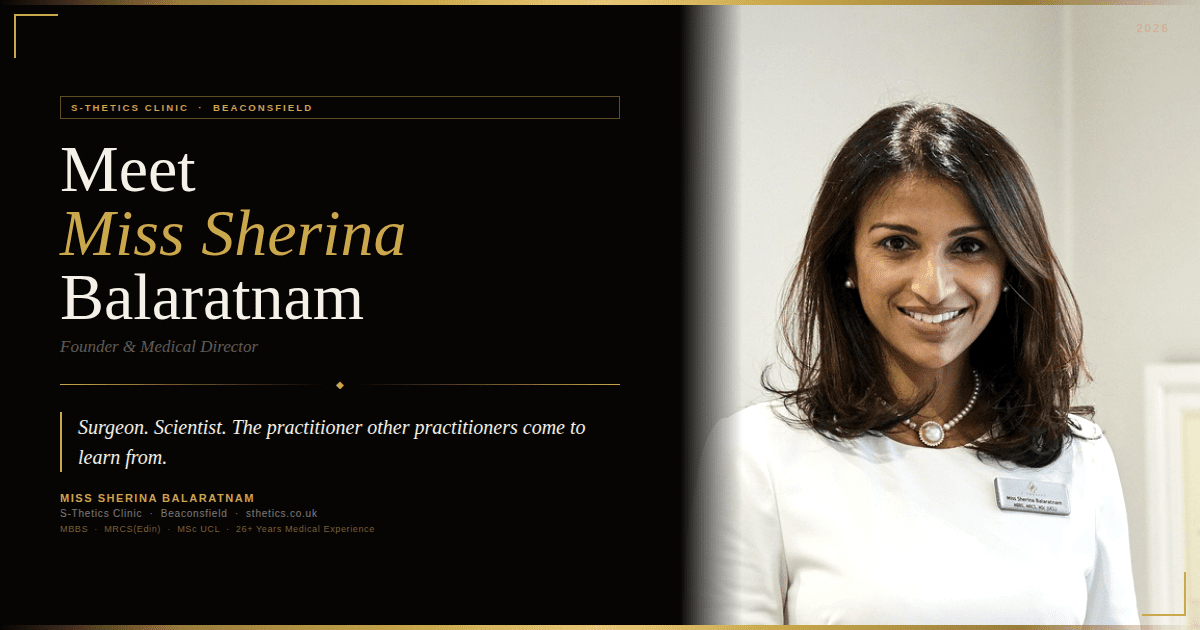
Miss Sherina Balaratnam is the Medical Director and Founder of S-Thetics Clinic in Beaconsfield. A qualified doctor for more than 26 years, she trained for seven years in NHS reconstructive plastic surgery before specialising in aesthetic medicine, in which she has practised for 14 years. She holds MBBS, MRCS (Edin) and an MSc (UCL), and is an international key opinion leader in facial aesthetics.