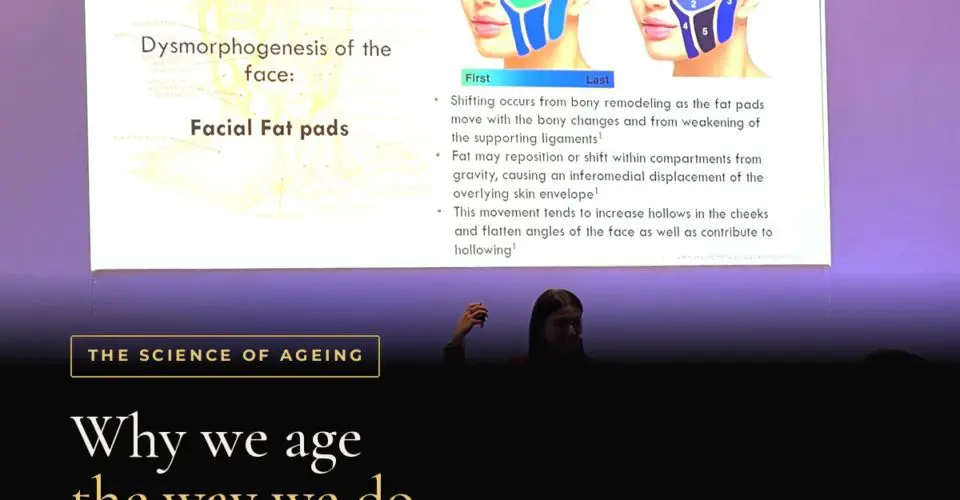
Invited to present on facial ageing and genetics at a leading UK facial aesthetics conference, Miss Sherina Balaratnam set out a view of the face that begins in the brain and reaches down to the gene. Here is what that science means for the way we treat ageing.
Most conversations about ageing begin at the surface, with a line here or a shadow there. The more interesting story sits underneath. Sharing the platform with senior academic colleagues, Miss Balaratnam explored a question that has occupied anatomists and surgeons for decades: why do we age the way that we do? The answer draws together embryology, anatomy, and the fast-moving science of genetics.
A surgeon’s reading of the face
Miss Balaratnam trained for seven years in NHS reconstructive plastic surgery before specialising in aesthetic medicine for sixteen years. That surgical grounding means she reads a face much as a structural engineer reads a building: in layers, from the bone outward. It is a perspective that shapes everything, from how she plans a treatment to how she talks about prevention.
‘The face does not age on the surface. It ages in its architecture, from the bone to the skin.’
MISS SHERINA BALARATNAM
The face begins in the brain
Not literally, but developmentally the face and brain are closely connected from the earliest stages of embryonic life. The facial skeleton forms largely from neural crest cells that migrate from the developing neural tube, and the growing brain acts as a structural platform around which the face takes shape. There is constant molecular communication between the two.1 Early embryologists described the face as reflecting aspects of underlying brain development. Understanding that connection helps explain why the face can never be understood as skin alone, and why it is such a faithful record of how we age.
How a face ages, layer by layer
Ageing is not one process but several, happening at once across four connected layers.4
- Bone: The facial skeleton remodels and recedes in predictable places. The eye sockets widen, the mid-face loses projection and the jawline softens, so the face appears to rotate and its angles to flatten.3
- Fat: Facial fat sits in discrete compartments. Some compartments thin while others shift or become less well supported, contributing to hollowing and changes in the contours of the face.
- Muscle: The muscles of expression are woven into the skin itself. As the skin thins, their pull becomes relatively stronger, which is how repeated expressions gradually etch themselves into lasting lines.
- Skin: Elastin production declines and collagen becomes disorganised over time, with the effects often becoming more visible from around the age of forty. Sun exposure accelerates the process, weakening the skin’s support and leaving it less able to recover.
For patients, these changes may appear as hollowing under the eyes, flatter cheeks, a softer jawline, jowls, deeper folds, or skin that no longer reflects light in the way it once did. Recognising them as a structural process, rather than as isolated lines, is the first step toward treating them well.
Programmed, or influenced?
If anatomy explains how we age, genetics is beginning to explain why we each age so differently. A large 2021 genome-wide study identified more than two hundred genetic signals associated with normal-range facial variation,2,7 although translating this into individual treatment planning remains an emerging field. More intriguing still is epigenetics, the layer of biology that governs which genes are switched on and off. Markers such as DNA methylation can act as a clock for skin ageing,5 and specific microRNAs are being studied for their role in collagen production, inflammation and skin repair.6
The encouraging conclusion is that ageing is not simply programmed and fixed. Genes are not the whole story: many visible ageing pathways are influenced by biology, environment, lifestyle, sun exposure, hormones and how early we begin to care for the skin and the structures beneath it.
Miss Balaratnam made the same case to an audience of more than 1,000 doctors at Masterhub Buenos Aires.
This does not mean that genetics can yet be used to prescribe an exact aesthetic treatment plan, or that ageing can be stopped. It means our understanding is becoming more precise. Anatomy explains how the face changes, while genetics and epigenetics may increasingly help to explain why individuals age differently.
What this means for our patients
This science is the foundation of how Miss Balaratnam practises. Because the face ages as a connected structure, she treats it as one, considering bone, fat, muscle and skin together rather than chasing individual lines. Because many of the changes are predictable, there is genuine value in beginning early and planning ahead. And because the future of aesthetics is moving toward precision and prevention, her approach stays firmly science-led: measured, considered, and centred on the person in front of her.
In conversation at S-Thetics, hosted by Francesca Ogiermann-White, Miss Balaratnam talks through the regenerative thinking behind her treatment planning.
Frequently asked questions
Why does the face lose volume with age?
Facial fat sits in separate compartments. Some thin while others shift or lose support, and the underlying bone remodels and recedes. Together this reduces support, which can leave the cheeks and temples looking hollow and the jawline less defined.
Can facial ageing be prevented?
Ageing cannot be stopped, but some important contributors to skin ageing are modifiable, particularly ultraviolet exposure, smoking, and aspects of lifestyle and skincare. Beginning thoughtfully and early tends to help.
Why does Miss Balaratnam treat the whole face rather than one line?
Because the face ages as a connected structure. Addressing a single line in isolation ignores the bone, fat and muscle changes beneath it, so a whole-face approach tends to give more natural, balanced results.
Miss Balaratnam discusses the role of facial injectables and what patients now want from treatment.
What is the role of genetics in facial ageing?
Genetics influences facial shape and how we each age, and research has now linked more than two hundred genetic signals to normal facial variation. Using this to plan an individual treatment is still an emerging field rather than everyday practice.
When should I start preventative aesthetic treatment?
There is no single right age. Because many changes are gradual and predictable, a whole-face consultation to understand your own facial ageing pattern can help you decide what, if anything, is worth doing, and when.
→ Book your consultation, including a full imaging session in our Aura suite: sthetics.co.uk/book
S-Thetics Clinic, 45 Wycombe End, Beaconsfield HP9 1LZ

About Miss Sherina Balaratnam
Miss Sherina Balaratnam MBBS MRCS(Edin) MSc(UCL) is the Medical Director and Founder of S-Thetics Clinic in Beaconsfield. She has been a qualified doctor for more than twenty-seven years, including a seven-year background in NHS reconstructive plastic surgery, and has spent sixteen years specialising in aesthetic medicine. She founded S-Thetics in May 2015 and is recognised internationally for her science-led, patient-centred approach to aesthetic medicine and longevity.
References
- Marcucio R, Hallgrimsson B, Young NM. Facial morphogenesis: physical and molecular interactions between the brain and the face. Curr Top Dev Biol. 2015;115:299-320. https://doi.org/10.1016/bs.ctdb.2015.09.001
- Richmond S, Howe LJ, Lewis S, Stergiakouli E, Zhurov A. Facial genetics: a brief overview. Front Genet. 2018;9:462. https://doi.org/10.3389/fgene.2018.00462
- Mendelson B, Wong C-H. Changes in the facial skeleton with aging: implications and clinical applications in facial rejuvenation. Aesthetic Plast Surg. 2012;36(4):753-760. https://doi.org/10.1007/s00266-012-9904-3
- Swift A, Liew S, Weinkle S, Garcia JK, Silberberg MB. The facial aging process from the “inside out”. Aesthet Surg J. 2021;41(10):1107-1119. https://doi.org/10.1093/asj/sjaa339
- Boroni M, et al. Highly accurate skin-specific methylome analysis algorithm as a platform to screen and validate therapeutics for healthy aging. Clin Epigenetics. 2020;12(1):105. https://doi.org/10.1186/s13148-020-00899-1
- Gerasymchuk M, Cherkasova V, Kovalchuk O, Kovalchuk I. The role of microRNAs in organismal and skin aging. Int J Mol Sci. 2020;21(15):5281. https://doi.org/10.3390/ijms21155281
- White JD, Indencleef K, Naqvi S, et al. Insights into the genetic architecture of the human face. Nat Genet. 2021;53(1):45-53. https://doi.org/10.1038/s41588-020-00741-7